Memories of San’in (Originally posted on 2022-Feb-7)

Last fall, COVID-19 epidemic slowed down and domestic travel demand returned. Tourist spots were crowded again, especially on weekends. As I do not like crowds, I need to travel in search of hidden gems.

Hidden gems were likely found in Hokkaido and Tohoku, but November was too early for snowy landscapes. So, I needed to find hidden gems in another areas.

Theoretically, a hidden gem is a place that I know but is not generally known to the public. If I do not know the area, I cannot distinguish whether it is hidden gem or not. I only can assume that a place where I do not know is also not known to the public, or I focus on finding less crowded places and perceive the entire area as a hidden gem.

For me, western Japan along the Sea of Japan coast is not familiar at all. I have not visited west of Hyogo on that side of Japan. Therefore I thought the San’in region as a whole could be considered as a hidden gem.

I decided to take this opportunity to visit the San’in region. Perhaps my idea was not too bad because it was relatively easy to get a seat on frequent flyer award ticket to Izumo on Japan Airlines.

The return trip was a bit trickier. Yonago Airport was too close to Izumo City, and Hagi-Iwami Airport seemed too inconvenient. I decided to go to the Pacific Ocean side and use Ube Airport, even though it is out of the San’in region. From Ube, All Nippon Airways (operated by Star Flyer) had an award seat available. Then the trip was rather long from Shimane to Yamaguchi.

The most famous hot spring in the San’in region is probably Tamatsukuri Onsen. No matter how much I consider the whole San’in region to be a hidden gem, it would be unreasonable to call Tamatsukuri Onsen as a hidden gem hot spring resort. After searching for a while, I found Yunotsu Onsen at the west of Izumo City and Yuya Bay Onsen at the west of Nagato City in Yamaguchi Prefecture. These might be called hidden gems as I did not know these places.

Between Yunotsu Onsen and Yuya Bay Onsen, I traveled on the San’in Main Line. I thought it would be easy just sitting on the train, but the travel time was long. There were limited express trains on the San’in Main Line, but they did not fit to my schedule. I had to take local trains, and the journey took about five hours. As I was already a middle-aged man, I wondered if my back would be all right.

On the first day, I took Japan Airlines early morning flight to Izumo City. From Izumo Airport, I took a direct bus to Izumo-Taisha Shrine where was famous for god of marriage. It may sound too urgent or even ghastly that a single middle-aged man heading for Izumo-Taisha Shrine without a second glance. However, that was not the case. Izumo-Taisha is a major tourist attraction in the San’in region. The bus was packed with people of all ages and genders. On the other hand, Izumo-Taisha Shrine might not be called a hidden gem though it was not as crowded as I imagined.

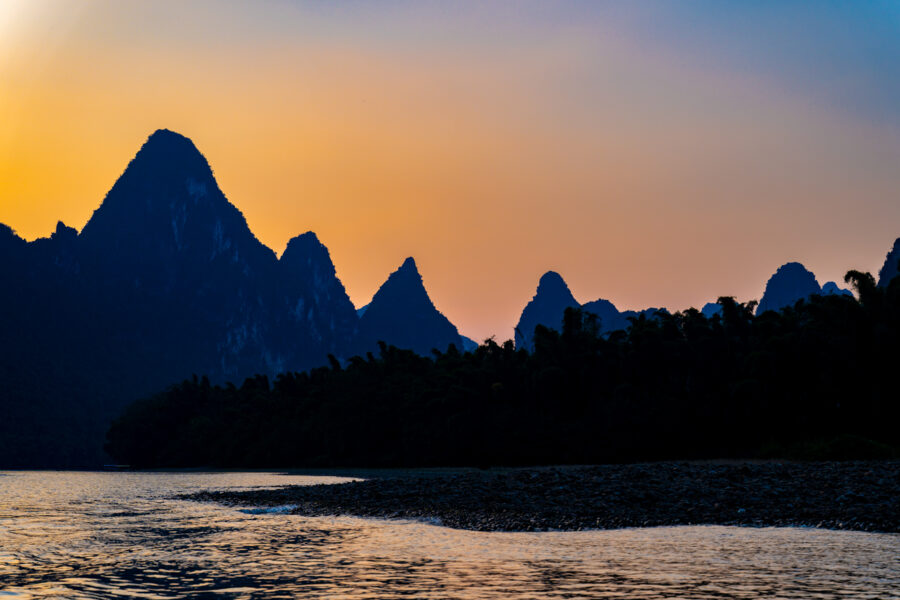
The reason I headed to Izumo-Taisha early was that I wanted to take another bus from the Izumo-Taisha Bus Terminal to the Hinomisaki-jinja Shrine. This is a hidden-gem shrine with only a few bus services available per day. The shrine is said to be the place of god where the sun sets. I thought this god or the shrine somehow fit me well.

The second day was almost lost by train ride. I headed west, taking it easy and enjoying the view of the Sea of Japan. There were two train transfers along the way, which made the train rides easier than I had expected. They were not crowded, thus the San’in region must be a hidden gem.

On the last day, I spent the day in Yamaguchi Prefecture. The most famous sightseeing spot on the Sea of Japan coast was probably Hagi, although it was back east from Nagato City. Alternatively, I could head further west on the San’in Main Line via Shimonoseki and go all the way to Ube.

Since the weather was fine, I decided to visit Akiyoshidai and Shuhodo Cave. Akiyoshidai was a famous tourist attraction, but I decided to go there because it was in autumn leaves season.

I intended to take a short walk in Akiyoshidai, but it turned out to be quite a trekking. In the end, I was able to spend a beautiful autumn day. Because it was Monday, there were not many people in Akiyoshidai, so I was able to take enough time to take photos.

Although I passed on Tamatsukuri Onsen, I did not miss the famous tourist attractions such as Izumo-Taisha Shrine, Akiyoshidai, and Shuhodo Cave. Yet, I was able to avoid the crowds and take my time on the entire itinerary.

Indeed the San’in region was a hidden gem.

COLO’s Traveler Guide: San’in (Originally posted on 2022-Feb-23)

Times shown are based on the timetables at the time of the visit.

Day 1

Tokyo Haneda 0710 (Japan Airlines JAL 277) >> Izumo 0835
Izumo Airport 0850 (Airport Bus) >> Izumo-Taisha Shrine 0930

– Izumo-Taisha Shrine

Izumo-Taisha Bus Terminal 1037 (Bus) >> Hinomisaki 1057

– Hinomisaki Shrine

Hinomisaki Lighthouse 1206 >> Izumo-shi Station 1313

Izumo-shi 1504 (Limited Express Super Oki 5) >> Yunotsu 1542

Overnight stay: Onsen Ryokan Masuya

– Night Kagura

Tips for Day 1
– While waiting train at Izumo-shi Station, went to Izumo soba restaurant nearby. The grilled eel and local sake “Kinunomine” were delicious.
– The night Kagura performances are held regularly in Yunotsu Onsen. Since the performances are held at a local shrine, it was more elegant than those held at theaters.

Day 2

Yunotsu 1054 (JR) >> Masuda 1242-1311 (JR) >> Nagato City 1502-1520 (JR) >> Igami 1542

Overnight Stay: Yuya Bay Onsen Hotel Yokikan

Day 3

Igami 0924 (JR) >> Nagato-shi 0946-55 (JR) >> Mine 1031
Mine Station 1110 (Bus) >> Shuhodo 1136

– Shuhodo
– Akiyoshidai

Shuhodo 1658 (Bus) >> Shin-yamaguchi Station 1735

Dinner: Nyudou

Shin-yamaguchi Station 1835 (Airport Bus) >> Yamaguchi Ube Airport 1905
Yamaguchi Ube 2010 (ANA 3186 operated by Star Flyer) >> Tokyo Haneda 2145

Day 3 Tips
– While waiting for the airport bus at Shin-yamaguchi Station, I went to an izakaya restaurant called “Nyudo” in front of the Station. The grilled mackerel sushi was superb. Thanks to the wonderful lady at the restaurant, I made it just in time to catch the airport bus. I wish to revisit this place.

Memories of Northern Akita

Recently I have been to Goshougake Onsen almost every year. I have participated in snow trekking led by local guide for two years in a row, but the weather was poor both times. Last year, the second time, weather was so bad that I was told “if you wish to take photos, you have to come when it is sunny.” Snow trekking for three years in a row seemed too much even for me. I thought I would go to Oirase to see this year’s snowscapes instead, but I had a work schedule so that I had to cancel the Oirase plan.

I am not a type of person who gives up on a trip because of the work, so I rescheduled it for the end of February. My last visit to Oirase in mid-February was a bit too late for snowscapes. I did not feel like doing last minute research, so I decided to go to Goshougake Onsen for this year too. I had to make the trip from Friday to Sunday, but it was unfortunate that the snow trekking guide was not available on Saturdays.

In general, access from Tokyo to Goshougake Onsen is via Morioka, but I usually go there via Odate to enjoy a chicken rice lunch box sold at Odate Station and a restaurant serving oyakodon (chicken and egg on rice) made with local Hinai Jidori chicken. I think the best route is to fly from Tokyo Haneda Airport to Odate-Noshiro Airport by All Nippon Airways (ANA) for onward journey. Return trip is to take Akita Nairiku Line from Takanosu Station near Odate to Kakunodate Station then change to Akita Shinkansen for Tokyo.

Since snow trekking was not possible this time, I decided to visit Moriyoshi Mountain Ski Resort along the Akita Nairiku Line to see the snow monster (juhyo). Moriyoshi’s snow monster season lasts until early March, slightly longer than Zao where is also famous for snow monster. Moriyoshi is located near Ani Matagi Onsen, where I had stopped for a day trip few years ago, I decided to stay there overnight. Basically, the route was the same as previous years but a few changes.

This winter had remarkable severe cold waves and heavy snowfalls, and even though it was the end of February, stormy weather was reported for the Tohoku region. Nevertheless, the weather seemed to change periodically, and it was forecasted to clear up on Thursday afternoon, the day before departure. That was a welcome development, but due to the periodical change, the weather was expected to deteriorate from Saturday afternoon even though I had originally planned to go to Moriyoshi Mountain on Sunday, the last day of the trip.

I called the hotels and they were kind to change the reservation. The revised itinerary was going to Ani Matagi Onsen on the first day, and then to Goshougake Onsen on the second day. I thought it would be an easy change since I would only be moving around in the northern part of Akita Prefecture but found out that it was indeed very difficult to switch the order using public transportation. Yet I decided to take a chance.

I took off on ANA from sunny Tokyo to Odate-Noshiro, but there were many clouds below as the plane passed the northern Kanto region. Gloomy weather prevailed over Fukushima and Niigata, and I felt gloomy as well. Even so, breaks in the clouds began to appear as Akita Prefecture approached. By the time the plane arrived at Odate-Noshiro Airport, blue skies had opened up. I guess I had cleared the first step.

From this point, I had a tight schedule. Although the ANA flight was delayed 5 minutes, the airport bus departed on time, and I was able to catch Akita Nairiku Line train as planned. From its Aniai Station to Moriyoshi Mountain Ski Resort, there was shared taxi service available but I had to wait for 30 minutes. This meant that I would only have about an hour to spend at the ski resort. Since the weather was forecast to be fine, I booked a regular taxi from Aniai Station. It was to say I bought the 30 minutes by paying the fare difference between the regular taxi and shared one.

When I arrived at the ski resort and took the lift to snow monster area, sky was clear behind the snow monster. I was extremely lucky because there were light clouds on the other side of sky. The snow monster area in Moriyoshi Mountain was not as large as Zao, but they provided good service to non-skiers perhaps there were not as many visitors as Zao. I borrowed boots and stocks at the lift station and strolled around in the mountain looking at the snow monster. When I went down the mountain by lift, I was just in time to catch the shared taxi back to the train station. It was good that I bought the 30 minutes as I was fully able to enjoy the snow monster.

From Aniai Station, I boarded the Akita Nairiku Line again and got off at Ani Matagi Station to go to Ani Matagi Onsen. When I went to the open-air bath before dinner, I found the sky was bathed in the sunset glow.

I thought I heard a voice from Goshougake Onsen saying “if you wish to take photos, you have to come when it is sunny.”

COLO’s Traveler Guide

The times listed are the timetable at the time of our visit.

Day 1

Tokyo Haneda 0855 (ANA719) > Odate-Noshiro 1005
Odate-Noshiro Airport 1020 (bus) > Takanosu Station 1040
Takanosu 1057 (Akita Nairiku Line) > Aniai 1156
Aniai Station 1200 (taxi) > Moriyoshi Mountain Ani Ski Resort 1220

– Ani Snow Monster

Moriyoshi Mountain Ani Ski Resort 1430 (shared taxi) > Aniai Station 1500
Aniai 1532 (Akita Nairiku Line) > Ani Matagi 1558

Overnight stay: Ani Matagi Onsen

Tips for Day 1
– I have been taking Odate-Noshiro flight that leaves Haneda Airport in the morning but it has been delayed several times in winter. I thought connection to 10:57 train from Takanosu would be tight. I had some backup plans to move from Odate-Noshiro Airport to Moriyoshi Mountain, but fortunately I was able to travel as initially planned.

Day 2

Ani Matagi 1054 (Akita Nairiku Line) > Takanosu 1220
Takanosu Station (taxi) 1220 > Odate Station 1245

Lunch: Hanazen (Chicken Rice)

Odate 1336 (JR Hanawa Line) > Kazuno Hanawa 1428
Kazuno Hanawa Station 1435 (shuttle bus) > Goshougake Onsen 1540

Overnight stay: Goshougake Onsen

Tips for Day 2
– It was difficult to move from Takanosu to Odate by train on this day. Akita Nairiku Line from Ani Matagi was not available until 10:54 after 7:19. Considering the breakfast time, the only choice was the 10:54 train. Then from Takanosu to Odate, there was only JR train that arriving Odate at 13:33 which made a 3-minute connection to JR Hanawa Line. Since both were JR lines, I could expect for a connection secured. However, considering the trip time from Kazuno Hanawa Station to Goshougake Onsen, the Hanawa Line train was definitely the one I did not want to miss. To avoid risk and to ensure time for lunch, I took another taxi on this trip.

Day 3

Goshogake Onsen 0930 (shuttle bus) > Kazuno Hanawa Station 1027
Kazuno Hanawa 1053 (JR Hanawa Line) > Higashi-Odate 1141
Odate Minamimachi 1149 > Odate Ekimae 1205

Lunch: Hanazen (Chicken Rice)

Odate 1350 (Express Tsugaru) > Takanosu 1405
Takanosu 1440 (Akita Nairiku Line) > Kakunodate 1641
Kakunodate 1718 (Komachi 40) > Omiya 2007

Tips for Day 3
– I planned to get off Hanawa Line train at Higashi-Odate and to eat Hinai Jidori chicken oyakodon, but Google Map showed that the restaurant was closed on Sundays. Not wanting to take a taxi anymore, I hopped on a local bus that would go to Odate Station at the very last minute. On the bus, I checked the restaurant’s website and found that they only opened for lunch on Sundays – Google Map was wrong. I went to Hanazen for the two days in a row. I love the place, so it was no problem at all, but I ate their chicken rice five times in three days including lunch boxes. That seemed too much even for me.