Memories of Tashkent

Tashkent is the capital of Uzbekistan. Compared to Samarkand or Bukhara, it is a city where is somewhat lacking in tourist appeal. Most travelers probably stay here just to transfer between the airport and trains.

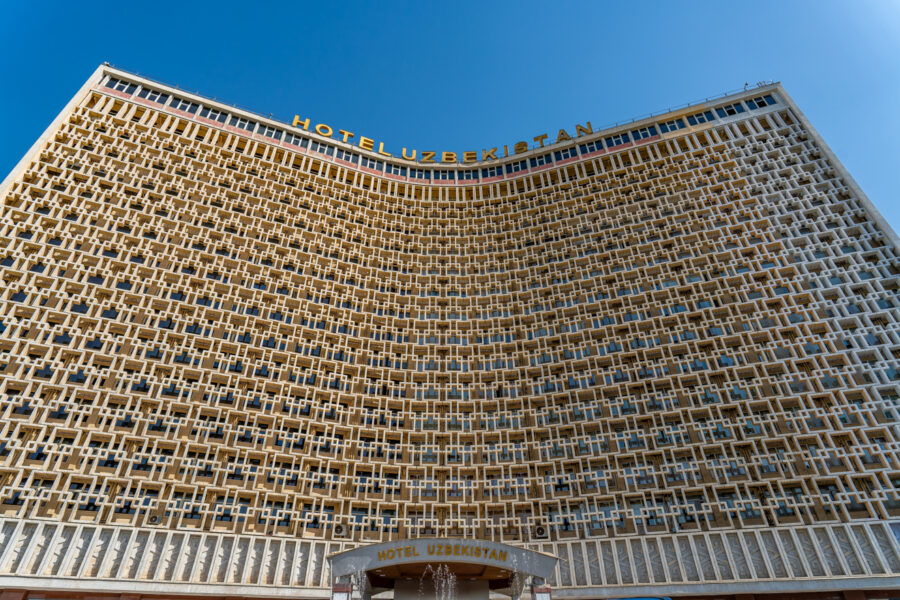
In Tashkent, there is a hotel called “Hotel Uzbekistan.” My wife’s co-worker knows a lot about “Stan” countries and says the building has a distinctive Soviet-style charm, apparently it is worth seeing.

It was easy to imagine that Soviet-style charm would not necessarily go hand in hand with comfort. However, I started thinking that if I was going out to see the hotel, I could stay there. Surely it would be more comfortable than that charming monastery in Bulgaria.

I had planned to stay in Tashkent on the day of arrival and the night before departure. Both stays were for connection with trains, I booked the two nights at a mid-class hotel near Tashkent Central Station. I decided to change the booking for the night before returning Japan to Hotel Uzbekistan.

Given its Soviet-era charm, Hotel Uzbekistan must be a large hotel. I expected to find availability easy, but booking turned out difficult. Whether it was because many travelers sought Soviet-era charm, it actually managed to balance comfort, or the hotel heavily discounted for group tours — I could not tell — but no vacancies appeared after several searches.

A week before departure, one room became available on a booking site, priced at around JPY25,000 per night. That was highest-end rate for a hotel in Uzbekistan, besides it was more than double of its regular charge. I had no choice but to pass. Vacancy might have been an error on the booking site anyway.

In the end, I gave up staying at Hotel Uzbekistan.

Since I could not get a high-speed train ticket back from Bukhara to Tashkent, I rode a regular express train for nearly six hours. By the return trip, my Silk Road sentiment had faded, and I just slept the whole way.

I woke up just before arriving at Tashkent Station, I tried to use my iPhone. However, it did not respond. Apparently, the train did not have WiFi, so that the iPhone kept searching for a phone signal in the middle of the desert while I slept. The battery had drained completely without I noticed about it. Since I did not have a portable charger, regretting that I should have kept the iPhone in airplane mode on the train was too late.

Not being able to use my iPhone in Uzbekistan meant I could not hail a car via ride-sharing app. Without map app, the subway was practically unusable too. My only choice seemed haggling with taxi touts.

However, this was the timing that turned misfortune into fortune. Since I could not book Hotel Uzbekistan, I simply had to return to the near-station hotel where I had stayed on the arrival day. I had taken a taxi to the station, but it was walkable distance even with a suitcase.

Though Uzbekistan is an Islamic country, I heard they produce beer, vodka, and wine. Being a fan of distilled spirits, I hoped that they would distill grapes and produce brandy. I even brought packing materials for bottles.

I researched that there was a winery in Samarkand, so I anticipated finding brandy there. However, I spent too much time photographing in Samarkand and unable to visit the winery. Moreover, even though the culture is relatively tolerant of alcohol drinking, it is fundamentally Islamic. I could not find liquor stores in Samarkand nor Bukhara.

Considering packing, I wished to buy fragile bottles before hotel checkout. The liquor store, where I bought beer on the day I arrived in Uzbekistan, was located on the walking route from the station to the hotel. When I bought beer, I checked they also sold brandy. I also confirmed the store was opened for 24 hours. My life is full of oversights, but I am thorough in moments like this.

When I went to the liquor store, perhaps for security reasons, I had to order through a window on the door during late night. I could not read the Cyrillic labels, besides I could not use translation app since my iPhone was not working. I was only able to judge by the age and price written in numbers. I pointed to the brandy with the highest age and bought it.

After returning Japan, I brought the brandy to a bar and it was delicious. I would just have to ignore the fact that it was made in Ukraine. In the times like these, I had no idea how the logistics system worked, but I would think of it as unexpectedly supporting Ukraine.

Tashkent was not a city that went exactly as expected, but it was also a city that went as expected. I suppose all’s well that ends well.

Besides, I am now fully sure that my life is full of oversights.

Memories of Uzbekistan

Yozan Uesugi, a famous virtuous lord of Yonezawa in the mid-Edo Period, had said “To achieve, one must act. To not act is to not achieve; this is true in all things. The inability to achieve is the result of inaction.” This is similar to an English expression “Where there is a will, there is a way.”

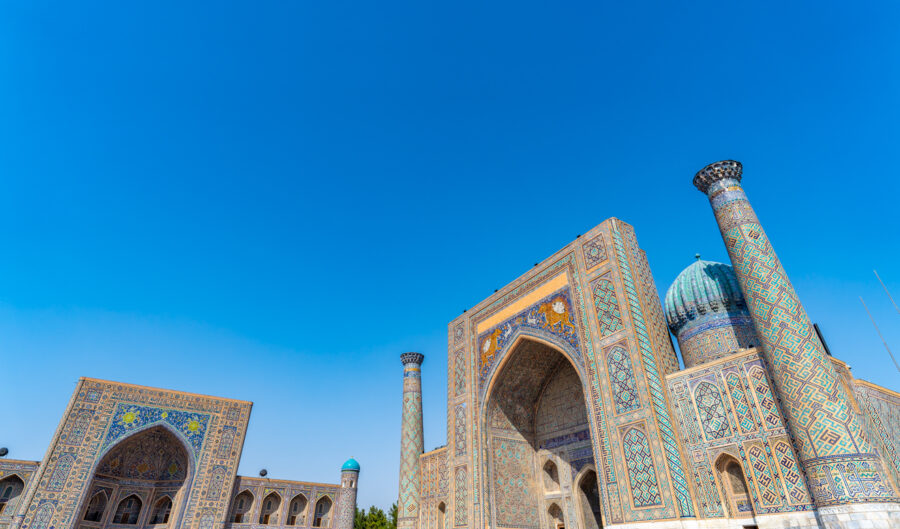
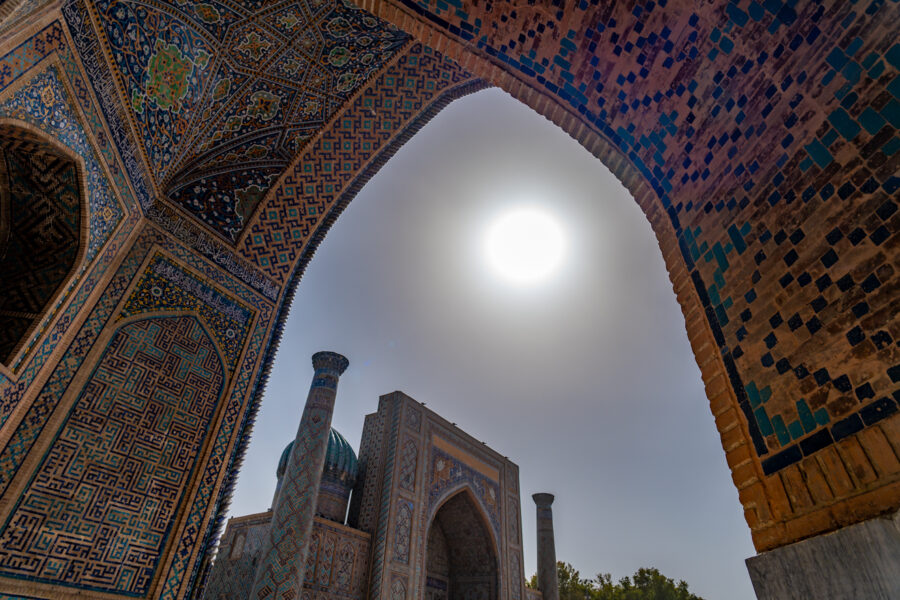
While searching for travel destinations a long time ago, I came across a square where had three massive blue Islamic buildings. Upon further research, I found it was Registan Square in Samarkand, a UNESCO World Heritage site in Uzbekistan. Apparently, I would fly to Tashkent, the capital of Uzbekistan, and then take a train from there.

It sounded simple. However, Uzbekistan was one of those “stan” countries, seemed like a difficult place to visit including all necessary pre-arrangements. The biggest problem was the schedule. Tashkent was not a place where can be easily reached using a red-eye flight from Tokyo. The travel in and out of Samarkand alone would likely take more than two days.

Back then, traveling via Seoul or Moscow seemed convenient. I kept in mind that Korea’s Asiana Airlines had 3-4 flights per week to Tashkent. Then COVID-19 travel restrictions enforced, and such memory sank deeper in my mind.

After all, it was like “where there is a way, there is no will.”

One day, a trigger that brought the memory back was the news of Asiana Airline and Korean Air would be merged. Asiana Airlines belongs to Star Alliance, so I can earn miles with All Nippon Airways (ANA). After the merger, Asiana’s mileage program will be a part of SkyTeam, which would be hard for me to manage. My motivation might be impure, but I started thinking it might be a time to go to Uzbekistan.

Around that time on a Friday, a gentleman sitting next to me at a bar raved about Uzbekistan. I probably listened more carefully than his drunk friend. We happened to leave the bar at the same time, so I struck up a conversation which I rarely did at that bar. He told me that while Uzbekistan is an Islamic country, being a part of former Soviet Union makes the country culture tolerant of alcohol consumption. He added that they produce not just beer, but also vodka and wine. Although he was not sure, but if grape producing country had distilleries, I might expect to find Uzbekistani brandy as well.

It was the time to have the “will” and believe that “there is a way.” I booked Asiana Airlines flights during the weekend.

I picked hotels using booking sites, but securing train tickets seemed like a hassle. Upon researching, I found Uzbekistan Railways tickets could be purchased online. It even allowed to select seats, so I aimed to reserve first-class car with single seating configuration.

However, while many sites suggested early advanced bookings were needed for trains, actual sale start date remained somewhat unclear. Many sites mentioned 45 days prior, but when I checked around 50 days ahead just in case, sales had already started. I needed to book three sectors, but availabilities were already limited: one sector with only one remaining first-class seat, one sector with a few remaining second-class seats but no first-class seats, and one sector available only for a train departing after midnight. I was completely late for securing train tickets. To make worse, I could not pay via the website. I hurriedly downloaded the app and managed to complete the payment.

After I purchased the tickets, I calmed down and re-checked trains via app. I saw that there were seats available on the days closer, so I started wondering if the release date might vary by train. I kept checking every few days, eventually tickets for lower-class trains had gone on sale. In the end, I never figured out the exact ticket sale start date, but I managed to connect all the segments almost on my desired schedule.

Preparation for this trip did not end with getting the train tickets. Just before departure, when I tried to print my reservation confirmation from the hotel booking site, something seemed off. Upon closer checks, I found that the booked hotel in Samarkand had vanished from the site. I e-mailed the hotel directly just in case but received no reply. This seemed highly suspicious, so I rebooked a different hotel. With departure only few days away, my options were limited.

This only bred suspicion. I contacted other booked hotels for minor reasons just to remind them of my booking existences. I planned to buy a SIM card at Tashkent Airport, but again, just to be safe, I purchased an eSIM in Japan before leaving.

I tend to be suspicious to others, but I do not learn much from my own mistakes. I drank too much the night before the departure. With almost no recollection, I flew to Seoul Incheon Airport from Tokyo Narita Airport. Next flight from Incheon reached Beijing airspace and headed west along the China-Mongolia border. It must have been a flight route steeped Silk Road.

Based on my research beforehand, the biggest obstacle was upon arriving at Tashkent Airport. There was an airport taxi counter inside the terminal, but its pricing was said to be too high. Once getting outside the airport building, touts for taxis were apparently relentless. It was recommended to use a ride-hailing app, but it seemed that these app drivers could not operate inside the airport. It was necessary to keep refusing the taxi offers until exiting the airport property on foot.

After clearing immigration and leaving the airport building, strangely, there were no touts of taxis. Indeed, no one approached me for any reason at all. I was thinking of charging through the swarm of middle-aged men and bolting straight to the road outside the airport premises, but there was no such chaos going on.

By then, my concern was the eSIM using LTE network, internet access was very slow. Still, the ride-hailing app worked, and I safely arrived the hotel near Tashkent Central Station.

I needed a nightcap before going to bed. While former Soviet Union culture made tolerance of alcohol consumption, I could buy alcohol drinks only at certain places. I asked where to buy beer nearby and went out for a liquor store.

The fatigue had not lifted by the next morning. This was definitely not due to the heavy drinking two days prior, but rather because I had COVID-19 two weeks before the departure and not fully recovered yet. Anxiety lingered for the journey ahead, but I mustered the willpower to get up and headed to Tashkent Central Station.

Since I was unable to secure a high-speed rail ticket, the train for the day was a regular express train with olden passenger cars. It was first class, but the seat was a bit worn. I had no time to blame such seat and fell asleep as soon as the train departed. After sleeping for about two hours, I woke up in the middle of a desolate wilderness. This must be the true scenery of the Silk Road. I drifted in and out of sleep as the train continued along the Silk Road.

The train arrived at Samarkand Station about 30 minutes late. I expected many touts for taxis here too, but there were only a handful. I quickly escaped from them and used a ride-hailing app to arrange a car to take me to the hotel.

It was before check-in time, but the hotel let me into my room. As soon as I left my luggage in the room, I decided to head straight to Registan Square.

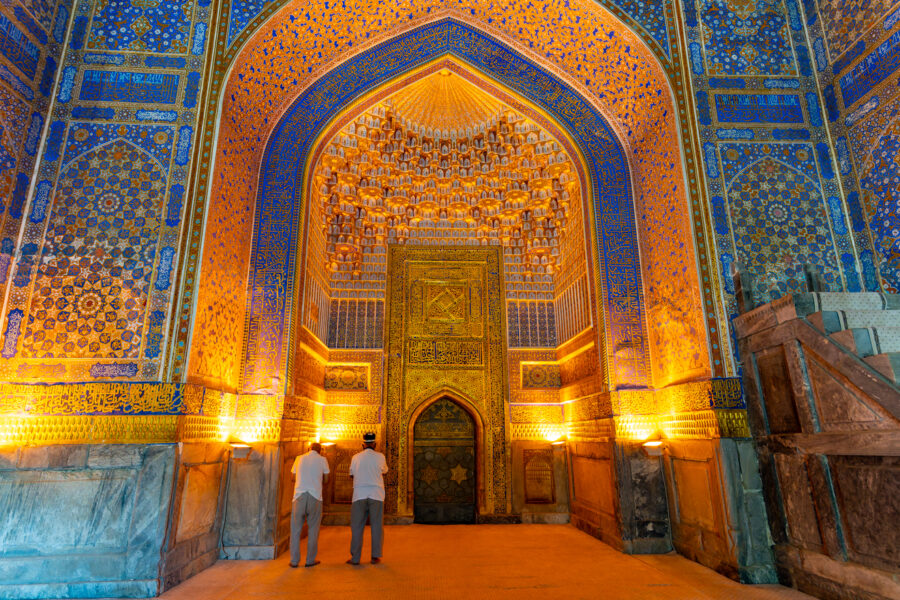
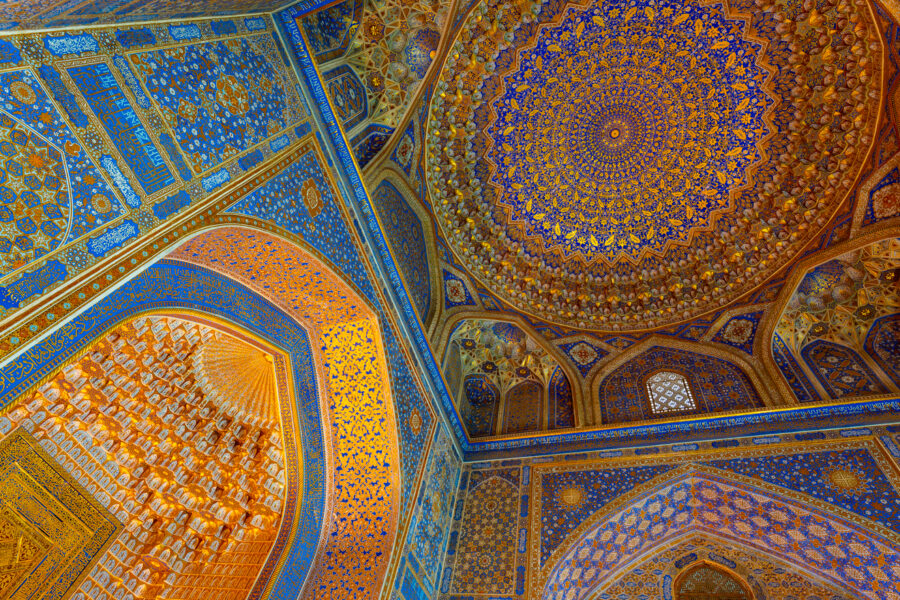
Thanks to the dry season, it was a clear, sunny day. Under the blue sky, I explored magnificent Registan Square. The mosque inside the “Tilla-Kori Madrasah” was especially stunning. After seeing the main sights at the Registan Square, I went back to the hotel.

It took a day and a half just to get the Registan Square, my Silk Road journey was finally over. Although it was a long way to come, “where there is a will, there is a way.”

In Uzbekistan, I thought I got closer to what Yozan Uesugi had said.
Memories of Hiroshima (Originally posted on 2023-Sep-24)

Back in June, I had to visit Hiroshima Prefecture. It was during the rainy season, so I was not fully excited, but it was fixed. Still, I made a small room to adjust my itinerary according to the weather.

There is an old town called Tomonoura in Fukuyama City, east side of Hiroshima, where I had been interested in visiting. It is a small old port town with an old lighthouse.

I decided to make an overnight stay at Tomonoura, take a boat to Onomichi, and from there take a scenic train on the Kure Line along Seto Inland Sea to Hiroshima Station. Although it was initially a short weekend trip only from Saturday to Sunday, I would be able to enjoy much of Seto Inland Sea if the weather is good.

As usual, I looked at the weekly weather forecast many times and found that the weather for Friday was supposed to be good but the weather for the weekend might not. I considered to forcefully change the original plan and started with a visit to Itsukushima Shrine in the afternoon on Friday.

Except for a short visit to a bar in Onomichi about 20 years ago on my way to Shikoku Island, this was my first visit to Hiroshima Prefecture in about 40 years. I remember seeing the Atomic Bomb Museum and Itsukushima Shrine and looked forward to riding “Blue Train,” a sleeper train, back to Tokyo when I was in elementary school. Even after digging up those memories, I have a few recollections, including the oddly long ride on the streetcar from Miyajima-guchi to Hiroshima City.

Anyway, for this time, I found that high tide at Hiroshima Port would be around 2:00 p.m. on the Friday. This was matched to the time of my visit. With expected sunny weather and high tide, besides I was in Hiroshima Prefecture anyway, I decided to go to Itsukushima Shrine.

The Itsukushima Island was full of tourists. When I looked the famous torii gate on the Sea, there were many buildings behind, on the other side of the Inland Sea. Not sure what I really expected, but Itsukushima Shrine was in a suburb of Hiroshima, which was a big city. Still, the view of the large torii gate on the sea was spectacular, and the background buildings could be removed by Photoshop.

As I was sitting on a bench and looking the torii gate, I imagined that my family had not checked the tidal condition when I first visited here. It might be difficult to completely forget the beautiful scenery at high tide. On the other hand, I heard that I could walk to the torii gate when the tide is low, which would have left me with some strong memories. From the fact that I do not remember any at all, I must have come here at a halfway time. As a result, all I recall in Hiroshima were that horrified memory at the Atomic Bomb Museum and long streetcar ride, but nothing on Itsukushima Shrine.

With these thoughts in mind, I paid my respects at Itsukushima Shrine and took pictures and then headed to Tomonoura.

It was cloudy in the early evening at Tomonoura but cleared up just before sunset. The entire sky turned pink just after sunset and gradually became dark blue. Because it was on a weekday, there was no tourist, locals do not seem to care. I enjoyed very colorful yet quiet evening.

I took a bus back to Fukuyama City center and visited to an old bar “Akatsuki”, which I had visited its Onomichi branch about 20 years ago. I recalled they had operated two bars back then. I have heard that the Onomichi branch was closed few years ago, but the Fukuyama branch was still in business. To my surprise, the bartender was 80 years old running his bar day-by-day.

It was a very satisfying day.

The next day was cloudy as predicted, and I continued my trip as planned. I drank sake while eating sushi lunch in Onomichi, drank cocktails on a scenic train which had a bar, and ate okonomiyaki with whisky highball in Hiroshima City. They were what I could not been achieved as an elementary school student. 40 years are long time. Some of years may have been wasted in my life, but I am glad to become an old man.

Although there are no Blue Trains anymore, I was able to fully enjoy Hiroshima Prefecture after the 40 years.