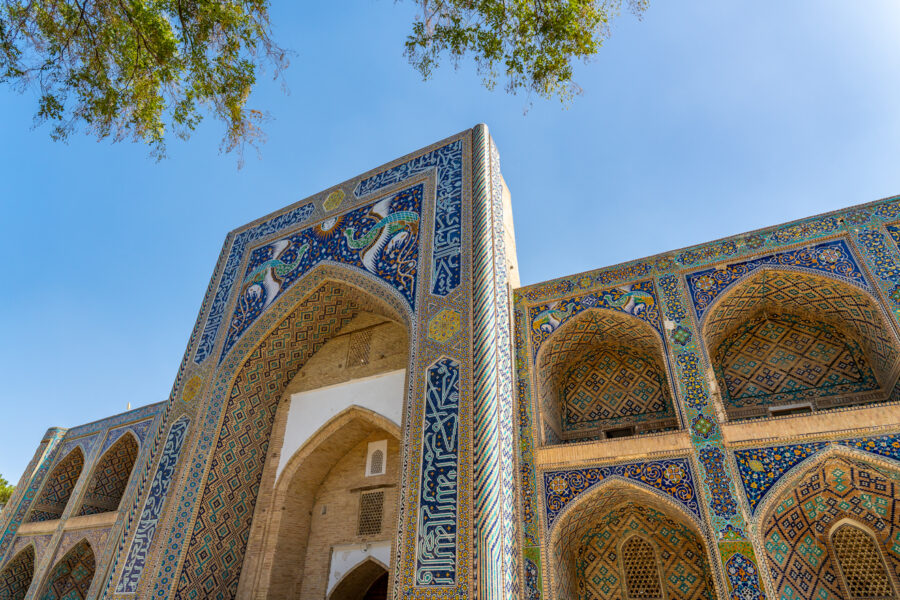
I wished to visit Uzbekistan before Asiana Airlines merges with Korean Air, but going only to Samarkand did not make sense. Upon researching, I found another ancient city called Bukhara. Roughly speaking using Japanese cities, if Samarkand is equivalent to Kyoto, then Bukhara is like Nara. There were other cities I wished to visit, but since I focused on spending time for photographing, I decided to limit my trip to these two cities.
When I arrived at Registan Square, I was thinking that my Silk Road journey had ended. However, there was more to come.
I managed to book a high-speed train from Samarkand to Bukhara. Having said, since both the high-speed train and regular passenger express trains use the same tracks, the only advantages of the high-speed train were newer cars and slightly shorter travel time.
I had reserved a restaurant in Bukhara that looked delicious, it turned out that the restaurant was in a hotel. I had originally planned to stay at a different hotel but ended up changing my hotel reservation to this place.
The hotel offered a free pickup service from the station, which was a huge help. The area around Bukhara’s old town has restricted vehicle access, and the hotel is tucked away down an alley. If I was dropped off outside the old town by a taxi, reaching the hotel would have been difficult.
Despite such strict traffic management is enforced, Bukhara is smaller than Samarkand and has fewer tourists. It was a relaxed city, free from the hustle and bustle.
In Samarkand, I had energetically photographed its magnificent and beautiful architecture, feeling extremely satisfied. Perhaps this is not unique to travel, but extreme satisfaction can be a double-edged sword. It is probably similar to the Confucian saying, “Too much is as bad as too little.”
To put it bluntly, by the time I arrived in Bukhara, I already had an “enough is enough” feeling for seeing historical buildings. It was a feeling similar to when I visited Scotland on distillery tour and was bored by the fourth distillery. However, distilleries had tastings and shops, there were still things to do even if I was bored, .
Bukhara was just as inaccessible as the Scottish countryside, so I could not lounge around the hotel. Fortunately, Uzbekistan has a culture that tolerant of alcohol consumption, so I decided to sip beer at an outdoor shaded table and leisurely explore the sights.
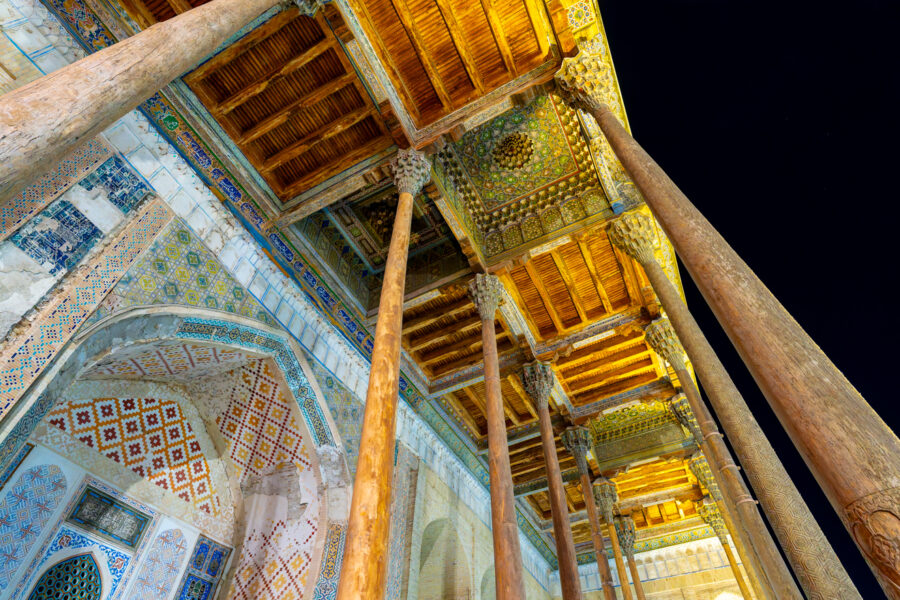
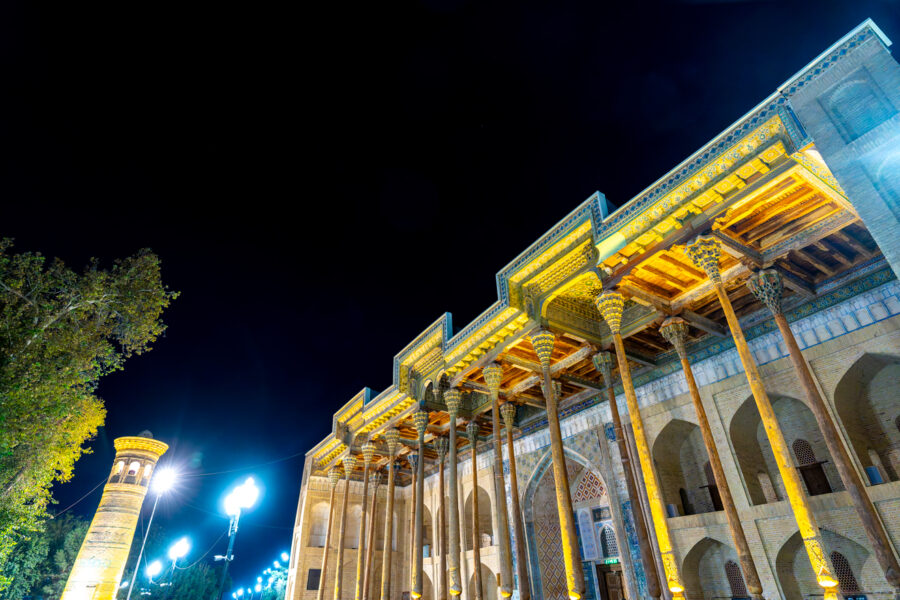
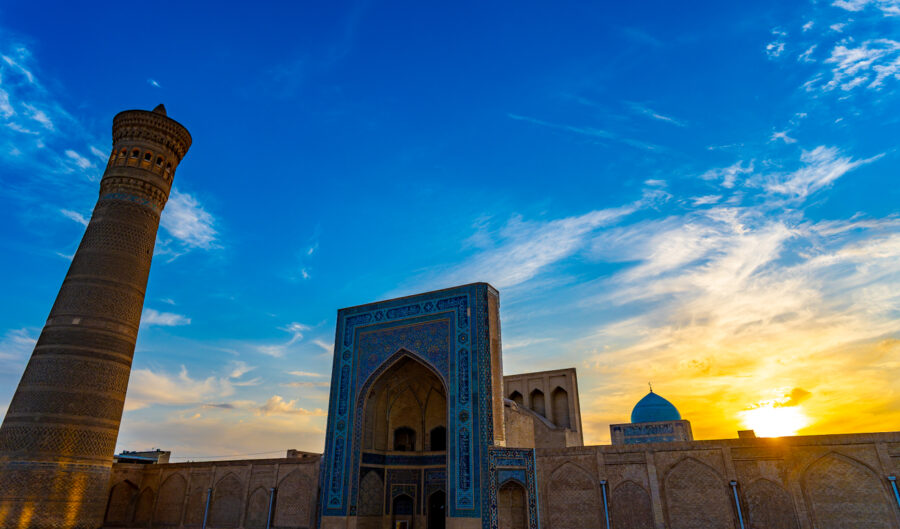
Bukhara has many UNESCO World Heritage sites, but I especially liked Bolo Hauz Mosque. I would call the Mosque as “unassuming”, but it was a relative term. The Mosque was built by the Royalty in front of their castle in 1712. Yet, compared to the historical buildings in Samarkand, it had a rather modest presence.
Pomegranate juice stalls stood at the square in front of the Mosque, and I sat on a bench gazing. At night, it was illuminated. Given my personality, it was inevitable that I ended up visiting multiple times.
On my last night in Bukhara, I took a tripod to photograph the night view. There were many carpets put in front of the Mosque. I realized that the following day was Friday. Many of Uzbekistan’s historical buildings, especially those of originally medreses (religious schools), have now become shopping sites but Bolo Hauz Mosque is an active mosque.
I could not manage to wake up for the dawn prayer, but the sign indicated the mid-day prayer was held around 1:10 pm. Since I planned to take the evening train back to Tashkent, that seemed like a perfect time.
On the next day, I left my luggage at the hotel and headed to the Mosque. The square where I had sat blankly with pomegranate juice the days before was covered by carpets and tents were set up to block the sun. I sat down on a bench outside the security perimeter while people gathered for the worship. An elderly man sat beside me, praying from there. When the worship was ended, he tapped my shoulder lightly and left.
While in Samarkand I had been focused on photography, I was able to enjoy the slow pace of time in Bukhara. A double-edged sword comes in handy when used right.