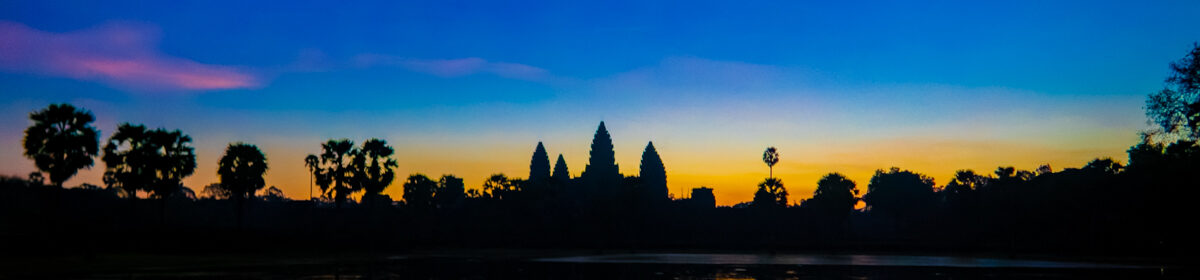
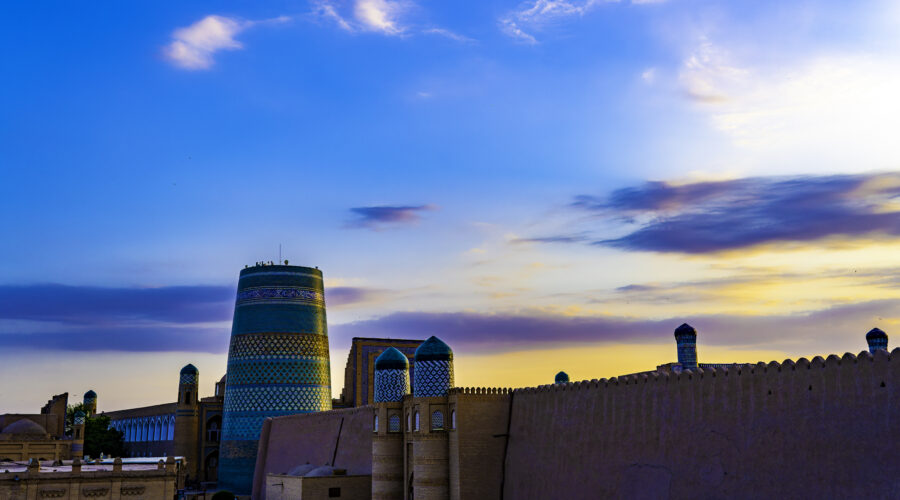
Kalta Minor Minaret at Sunset
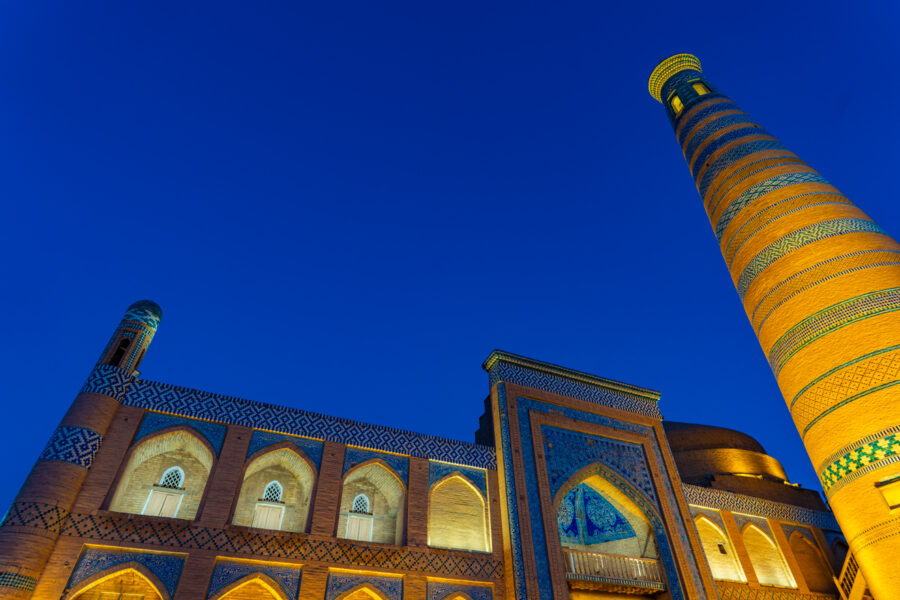
Islam Khodja Madrasah & Minaret at Night
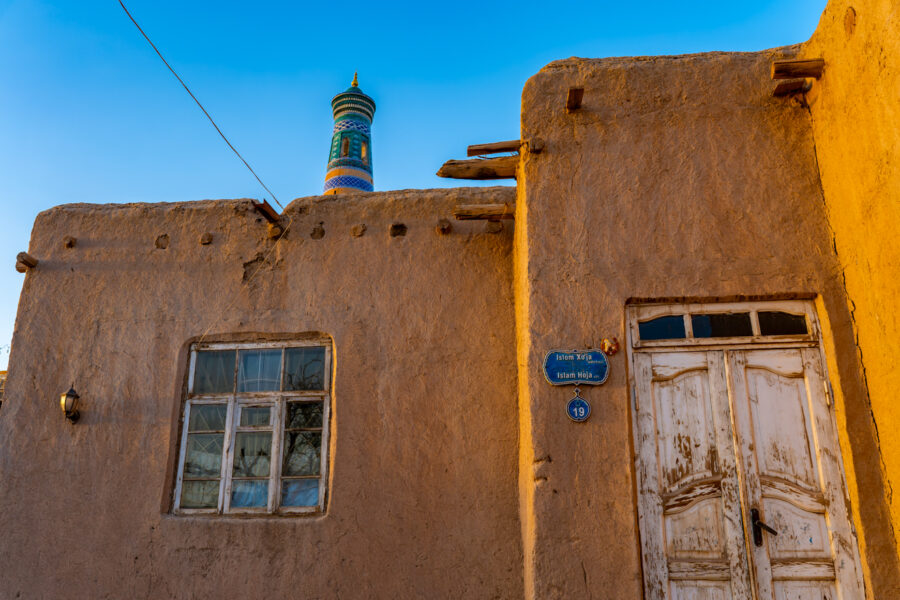
A House Behind the Islam Khodja Minaret
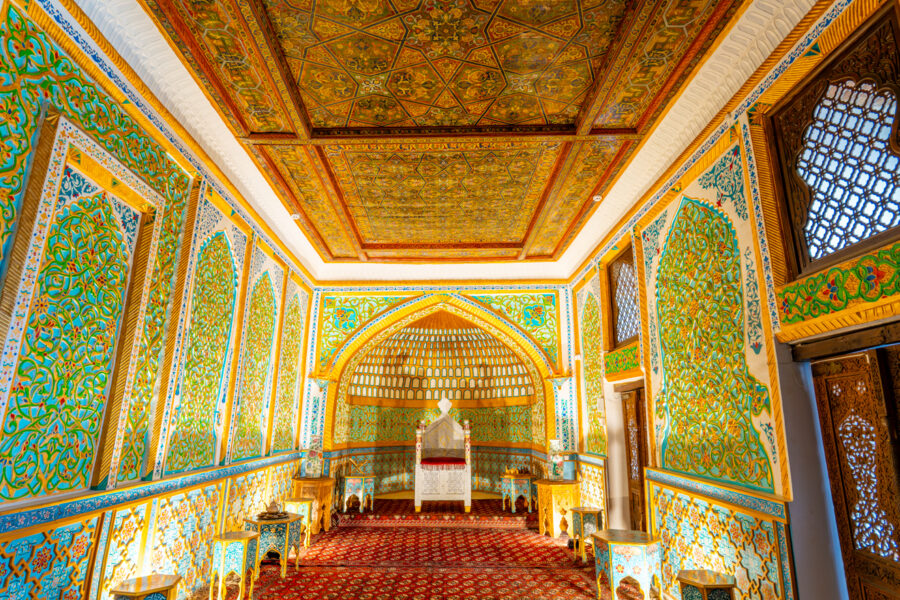
Throne Room in Kuhna Ark
While Samarkand is Uzbekistan’s most famous ancient city, Bukhara and Khiva are other renowned historic cities in the country. By planning an itinerary with efficiency in mind, it is possible to visit all three cities on a nine-day trip from Japan. However, since my trip was focused on photography, I felt that visiting two cities was the max. Samarkand was a must, and after some consideration, I chose to go to Bukhara last year.
A major reason I decided to visit Uzbekistan again this year, making it two years in a row, was my desire to see Khiva. Khiva still retains its old town with city walls called Itchan Kala, a World Heritage Site. I looked for a hotel near the center of the old town, but places that looked promising were already booked while others were rather underwhelming such as cramped rooms. In the end, I booked a hotel located a short distance from the center.
Judging from hotel booking sites, the hotel looked quite nice; yet no credit card was required to guarantee the reservation. Honestly, this made me uneasy. I encountered a situation where advance payment via wire transfer was demanded. I also recalled an incident last year that a hotel I had booked in Samarkand had ceased business. Even though I suspected it would cost more than a ride-hailing app, I requested a transfer to the hotel just to let them know that I would be there as per booking. They might have trusted me, but I did not quite share same level of trust.
After the trouble getting on the sleeper train, I arrived at the hotel in Khiva. I had imagined that the city walls called Itchan Kala was a part of Khiva old town; but in reality, the Itchan Kala was the old town itself. Consequently, the hotel “located a short distance from the center” turned out to be a hotel located outside of the old town. I noticed them as I arrived, and to be honest, they made an unexpected surprise. Yet, the city gate was about a minute’s walk away. I dropped off my luggage and headed out to explore the Itchan Kala.
Entering the Itchan Kala requires passing through the city gates. The gates nowadays have ticket collectors instead of gatekeepers, saying that there is an admission fee just going into the Itchan Kala. Again, this was an unexpected surprise. From the time I had missed the train at Samarkand Station, the day was filled with unexpected surprises. They were clear cases of my own insufficient research; I had to start by checking the price list at the ticket booth.
There were few types of tickets available, that were a bit complicated. If I bought the ticket that included museum admission, I would have access to the Itchan Kala for two days. Since I planned to stay in Khiva for three nights, I decided to buy a simple entry ticket to the Itchan Kala on the first day, then to buy the two-day ticket on the following day.
Stepping inside the Itchan Kala, I found a remarkably well-preserved old town that felt like a completely different world. While inside the walled city of Dubrovnik had also felt otherworldly, Khiva surpassed Dubrovnik. As my first day ticket did not cover museum entry, I spent the time wandering the streets and relaxing at an outdoor cafe with a view of beautiful minaret. Clouds rolled and I could hear distant thunder; I was able to enjoy even more atmospheric evening.
In the following morning, I bought a museum-access ticket and began sightseeing. This ticket was a bit complicated too. While the ticket allows unlimited entry to the Itchan Kala for two days, if I wish to re-visit even one museum, I have to buy another two-day ticket. Furthermore, religious sites require separate fees. Since museums are originally mosques and madrasas (Islamic school), it is not always clear which places incur extra charges unless carefully examine a map.
Unfortunately, Juma Mosque, the site I most wanted to see, was under preservation work; I was only able to see half of it. Despite its name, Juma Mosque is classified as a museum rather than a mosque.
Considering I can visit religious sites multiple times by paying entrance fees, it is best to pick museums in advance and visit them in the morning when there are fewer tourists. After all, visiting Itchan Kala requires sufficient research. I was not supposed to be standing at the city gate with unexpected surprises after arriving at Khiva.
While strolling through the Itchan Kala, I happened to pass by a woodworking workshop. Uzbek mosques make extensive use of wooden pillars and doors, all featuring intricate carvings. I usually avoid these kinds of workshops because, even if admission is free, it feels awkward to leave empty-handed. However, since I was deeply impressed by Bolo Haouz Mosque in Bukhara last year, I decided to step inside. I would surely not end up being pressured into buying a wooden pillar.
A craftsman worked hard. I was allowed to take photos and see the finished pillars and doors up close. Before leaving, I checked out the shop area. There were elaborate carvings featuring Islamic patterns that I wanted to buy a piece; but there was no one around and no pressure to make a purchase. It is a hassle to shake off sellers at workshops where I am not interested; yet when I actually want to buy something, there is no seller around. I asked the craftsman to call over his master.
While Khiva is a city where is somewhat difficult to combine with Samarkand visit, I was quite satisfied. Although I had an unnecessary hard time getting Khiva, it was certainly worth the effort. Since there is an airport in a nearby town, taking a domestic flight to/from Tashkent for one leg of the journey allows a reasonably efficient travel itinerary even in my style.
On this trip, I made multiple unexpected surprises due to lack of research. Therefore, it is possible that there still are hidden insufficient research, I have managed to visit all cities in Uzbekistan that I can think of now. With these, I will not need to go to Uzbekistan three years in a row. Well.. maybe.