Memories of Tainan (Originally posted on 2024-June-10)

Since my trip to Taiwan was mainly for my mother, I thought I would keep the itinerary simple, with little effort required to move around. Still, I wanted to add a twist, so I decided to spend one night in the port city of Keelung near Jiufen, and another night in Taipei. This way, we could complete our trip within northern Taiwan and see cities other than Taipei.

I am now not sure if it actually made sense in the end, but in order to avoid crowds, we had decided to stay in Jiufen on a weekday, which meant we would go there on Friday as we arrived in Taiwan. Since it is possible to travel from Jiufen to Keelung by direct local bus, the next day, Saturday would be the overnight stay in Keelung. As a result, the third night in Taipei to be Sunday night.

However, after making all the arrangements, I found out that public local markets in Taipei are closed on Mondays (at least Google told me so). No matter how reasonable the route itself was, as a local market lover, I felt that the last day of our trip would be uninteresting one. Moreover, the private kitchen that impressed me during my last visit had been closed. Should we continue to Taipei on our last day?

My wanderings began.

I started looking travel guides and YouTube every day. There were many choices, but if all we did was move around in Taiwan, it would be contrary to my original purpose and it would be too packed in itinerary. After much consideration, I came to a conclusion that the city of Tainan seemed like a good choice. Tainan is a city in the southern part of Taiwan, where the old cityscape still remains. We decided to stay two nights in Tainan, forgoing overnight stays in Taipei and Keelung. When we finally decided to stay in Tainan, it was less than two weeks before departure, and we had a hard time finding a good hotel.

After returning to Taipei from Jiufen, where was chilly and drizzling, we took the Taiwan High Speed Rail from Taipei. Although the distance is long, the trip takes only about two hours, and the seats are reserved. When we arrived in Tainan, the weather was sunny and almost sweaty. It was like in an another country.

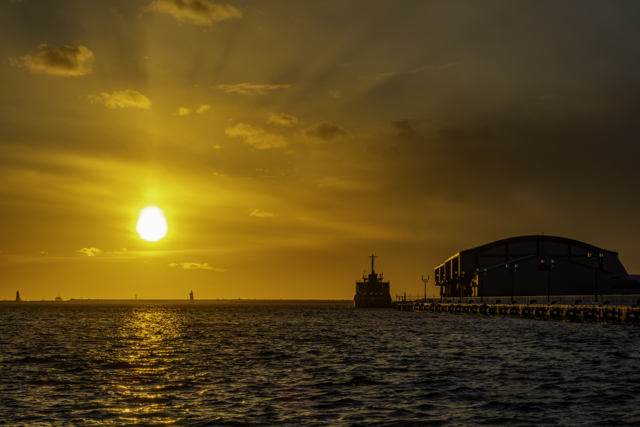
In Tainan, I wanted to visit the ruins of an old warehouse called Anping Tree House, so we headed there first. I was able to capture beautiful oblique light in the early evening. If I had gone to Keelung as I originally planned, I would not be able to get out of the cloudy weather, so it turned out to be a great decision.

For dinner that night, we went to a private kitchen that I had selected from a list of restaurants made by my Chinese-speaking friend. I went there thinking it was a Cantonese-style restaurant that also served Western-style food, but it turned out to be more delicately flavored than I had imagined. It was worth overcoming to make a reservation and other arrangements, and this restaurant alone made me feel glad that I had come to Tainan.

Full-day sightseeing began the next day. We started with an early morning visit to local markets. After purchasing some snacks at the market, we returned to the hotel, took a rest, and then walked around the city’s tourist spots. The city was delicately large and we cut about half of the places we wanted to visit, but we still had to walk about 14 kilometers on this day.

Tainan was extremely interesting and very enjoyable, Taiwanese culture was influenced by Dutch and Japanese rule era. There were some places I missed and there seemed to be many charming back alleys. It is a city I would like to revisit.

Although I used UBER and took breaks from time to time during this trip, the distance we walked during the four-day trip was about 40 km. While I was able to adjust our air and rail travel schedule, as a sightseeing trip for an elderly person, this probably meant that we walked too much.

I tried to reduce the amount of effort required for travel, but it seems that I could not change my travel style. I am a selfish old son after all. By the way, my mother is 80 years old this year, and she is taken care by the same acupuncturist as myself and wife, who says my mother is in the best in health among the three and I am the far worst.

I guess that means I should take care myself without thinking about other things.

Memories of Jiufen (Originally posted on 2024-May-27)

Last December, when I caught a flu-like cold, my mother came to my home with relief supplies. While we talked, she told me that she wanted to go to Jiufen, Taiwan.

I looked up the weather in Taiwan and found that it generally has a rainy season from April onward for about six months. I take my trips seriously and try to act quickly. I decided not to wait until next season. Looking up the calendar, there were two three-day weekends in February this year, but one of them was tied with Chinese New Year, so I decided to pass. I decided to take one day off to make it a four-day trip, as I thought it would be too much to take my mother on a lightning trip.

This was my second visit to Taiwan, and I had heard that Jiufen was extremely crowded. The last time I visited Taiwan was a 2.5-day weekend starting on a Friday afternoon, I did not go to Jiufen nor the National Museum in Taipei to avoid crows.

To avoid the weekend crows, we decided to spend one night in Jioufen on a weekday this time.

On the first day of the trip, we arrived at Taipei’s Songshan Airport around noon. Since this airport is located in Taipei City, we decided to take the UBER directly to Jiufen. It was cloudy when we left Taipei, but gradually began to drizzle. By the time we arrived in Jiufen, it was completely raining.

The inn where we stayed was located at the back of a public parking lot, but the parking lot was already overflowing with tourist buses. We gave up driving to the front of the inn and headed out on foot in the rain. Although nothing to do with the UBER driver nor Jiufen town, I started to have a bad feeling. I had my umbrella in my suitcase but unable to take it out in the rain, however, that was not the point of the problem.

We left luggage and went out to the town, it was already crowded. It was crowded as if I had come to see tourists. It was past 2:00 p.m. at that point, but since the town is famous for its night view, the number of people would probably increase as the evening progressed. Moreover, it was extremely difficult to walk in the narrow alleys with umbrellas. It was not good in any way. There was a coffee shop with a good view, so we decided to escape and see what was going on.

Even after spending some time at the coffee shop, the rain had not stopped, and the road below us was jammed with buses. There was no sign to get any better, so we gave up and decided to return to our inn.

I had heard that the tourist crowds would be decrease after around 8:00 p.m., when local buses from Jiufen back to Taipei would stop running. At 7:00 p.m., we went back into town again. The rain had not stopped, and the streets were still crowded, though perhaps a little less than at 2:00 p.m. Jiufen is a town of steep hills, and returning to the inn at the down of the hill is tedious and strenuous. We went into another coffee shop to kill time again. Although there is nothing bad about the cafe, it was not good in any way.

When we left the coffee shop at 8:00 p.m., the crowd had finally reduced. The rain did not stop, but we finally reached the front of a teahouse, a famous tourist attraction. I heard that there was another teahouse in front of this famous teahouse that had a viewpoint, so I went in to take some pictures.

In Japan, I rarely go a cafe, but this was the third time in half a day since I arrived in Taiwan. I have not consumed any alcoholic beverages yet, not even a glass of beer, despite the fact that I have consumed too much coffee or tea on that day. It was not good.

The only meal I had on this day was in-flight meal. I felt hungry, but meal serving time at the tea house was already over. It was not a good day.

While we were having cups of tea in traditional manner with a view of night scenery, my mother seemed to be cared by lao ban, an elderly gentleman of the tea house. After talking in Japanese for a while, he gave us a bento box. It must be an extra box made to tourist groups, but it was quite tasty. He even lent us plates to serve it on. Thank goodness for that. Finally, I could not wait any longer and said, “Lao ban, can I have a beer, please?” It was nice that Japanese was understood.

The rain continued until the next morning and it became a drizzle just before we left, but it was cloudy anyway. There were less crowded in the morning, so I ran up the hill for about 15 minutes to the famous teahouse to take pictures.

I heard that it rains a lot in Jiufen, not only on this day, but also throughout the year. It is too touristy place to take pictures. No matter where you take pictures, they will all look like pictures you’ve seen.

In the end, the only good memory of Jiufen was the bento box. It was thanks to the lao ban who made Jiufen into an unimportant place for us. 真是謝謝你.

Memories of Hakodate (Originally posted on 2024-Jul-01)

I have not been feeling well since the end of last year. At first I thought that I had entered a “bad luck cycle” that is common in my life, but things did not improve and my physical condition was not good either. The cause of all the problems seemed to be insomnia, according to my acupuncturist, which was highly likely owing to my high heart rate even while I am at rest. The results of medical checkup showed that there was no problem with the heart itself, so it must be an autonomic nervous system problem. I decided to purchase an Apple Watch and monitor my health status.

After a 4-day trip to Taiwan in February, the situation was improved. My heart rate dropped and my insomnia somewhat eased. However, the golden time was over after three weeks. Hay fever triggered another bad cycle, things were even worsening due to natural factors such as typhoon-class low air pressers coming almost every week and harsh temperature fluctuations in this spring. The insomnia worsened as my physical condition was weaken.

My acupuncturist and I share the same view that fundamental solution to my autonomic nervous system problem is quitting my job, but that simple solution will likely to lead other problems. It seems to me that an effective strategy getting better would be to go on a trip.

It was around the end of March, but I did not think I can wait until Japan’s Golden Week holidays in May. I decided to go to Hotel Keifu on the outskirts of Hakodate, which I had planned to visit in late fall. I have decided to make the trip advance. Since the purpose of this trip was self-therapy, one-night trip would be too short. After some research, I found out another hotel named Hotel Hakodate Hirome-so, also on the outskirts of Hakodate. I also found that When I stayed two-nights in a row, they would provide a shuttle service between accommodations. Since there is a favorite high-end sushi restaurant in Hakodate where I may visit at the end of the trip and I have heard that no hay fever in Hokkaido, it would be a perfect escape from reality.

Even though I omitted spring break period, there were no seats available on frequent flyer award ticket for the flight leaving Tokyo on Saturday morning. In fact, the plane itself was nearly full. Rather than having a seat in the middle of three-rows of seats at a fare close to the full amount, I decided to take the Hokkaido Shinkansen even if the ride took four and a half hours. For about the same fare, I could ride in the green car (upper class). Since I would be sleepless at night, it would be good to get a sleep while on the Shinkensen.

I bought a beer at Tokyo Station for a morning nightcap (or whatever called in English), but before I could finish it, I lost consciousness around Ueno Station, and when I opened my eyes a few seconds later, I was already in Aomori. I didn’t even notice Sendai or Morioka Stations on the way. By drinking a stale, room-temperature liquid, I passed through the Seikan Tunnel with my consciousness often losing, then arrived Hokkaido Island. With this much sleep while moving on the Shinkansen, the green car ticket would have paid for itself.

When I arrived in Hakodate, the weather was clear and the temperature was hot. It was so hot that it seemed a different city where I had been freezing in a snowstorm a few months back.

I took a streetcar from Hakodate Station to Jujigai. After a lunch at Gotoken, a favorite curry restaurant, we boarded the hotel’s shuttle. On that day, the Tsugaru Strait had a calm seascape. After arriving at the hotel, I went out to see the nearby Todohokke fisheries port and lighthouse.

I went to bed early on that night, perhaps tired from two hours of walking around, or perhaps from the good effects of the self-therapy.

The next morning, I was in bad condition. Was the effect of the self-therapy an illusion?

I went out for another walk to take some pictures. It was warm again that day. As I walked, my eyes were caught by a cedar tree with a disturbing brown color – bad sign for cedar pollen.

I guessed that the reason for my poor condition that day was hay fever. This was completely unexpected. I heard that only birch trees could cause hay fever in Hokkaido Island, but it might be a different story in southern Hokkaido. It is true that about 20 kilometers across the Tsugaru Strait from the hotel is Honshu Island. Therefore, it would not be surprising if there were some cedar trees growing in the area. Unlike the Kanto area, where pollen dispersal was just about to over, this was probably the peak of the season in southern Hokkaido.

I have hay fever only from cedar trees, not from birch trees for sure. I thought I would not have hay fever, and did not bring any medicine with me. Moreover, there was no drugstore in the neighborhood in remote area of Hakodate.

Even so, thankfully my hay fever did not get much worse, perhaps because there are fewer cedar trees in the forest, or perhaps because there are fewer air pollutants.

When I returned to Hakodate city central in the afternoon of the last day, I finally found a drugstore. I thought I would be okay to return from Hakodate without any medicine, but the last and biggest event of the trip, the dinner at high-end sushi restaurant was planned just before my return flight.

I rushed into the drug store. There was a shelf of nasal inflammation medicine, but as much as seen in the Kanto area. I wondered if the demand was rather low. Still, the medicine was the same.

I finished up my trip at the sushi restaurant without a dripping from my nose. On the return flight, there were seats available on the award ticket, I took the last flight back to Tokyo. The weather was fine during the trip, and I returned to Tokyo extremely satisfied.

As I was sitting on the express bus from Haneda Airport to Yokohama Station, my Apple Watch beeped just before the Yokohama Bay Bridge as the bus entered Yokohama City. My Apple Watch was set to sound an alarm when my heart rate exceeds 120 beats per minute at rest. By the time I arrived at Yokohama station, it had calmed down to about 100. There was no way I could sleep when I got home in that state, and my insomnia returned back.

Is a three-day trip not enough time to deal with insomnia? Or do I need to have a passport for a self-therapy trip?

It is possible that the idea of traveling as self-therapy is an illusion. However, I would like to avoid the fundamental solution to my autonomic nervous system problem, so I need to devise a different coping remedy.

In order to come up with a new strategy, I need to reexamine my life from a new perspective. In order to make a fresh start, I decided to go to travel first.

You cannot copy content of this page